Pathogen Genomics for Epidemiology: Interpretation
Image
Pace
Self-paced
Subject
Difficulty
- Advanced
Platform
Continuing Education from Harvard Medical School
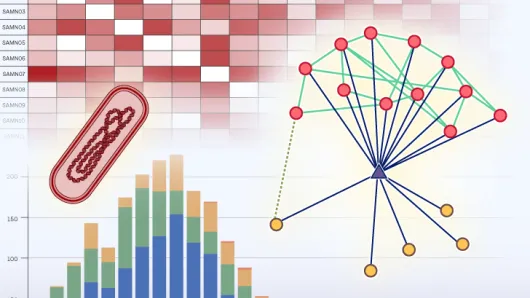
Explain how common genomic outputs (such as time-series plots, genome maps, distance matrices, networks, and phylogenetic trees) are used in pathogen characterization, surveillance, and outbreak investigations — including what they reveal about pathogen features and transmission, and the key limitations of these data.
Apply an integrated understanding of pathogen biology, genomic data, and epidemiologic context to interpret genomic results in a variety of public health investigation scenarios.
Recognize how factors like sampling approach, sequence quality, and available epidemiologic and clinical data affect the interpretation of genomic findings and the strength of conclusions that can be drawn.
Pathogen Genomics for Epidemiology: Interpretation focuses on making sense of genomic data for public health decision‑making, including pathogen characterization, surveillance, and outbreak investigations.
The first section introduces common genomic representations of genomic data—including database comparisons, time‑series plots, distance matrices, network diagrams, and phylogenetic trees—clarifying what each represents, how it is used in epidemiologic investigations, and key considerations for use and interpretation.
The second section examines factors that shape patterns observed in genomic data. You will consider how pathogen biology, mutation rate, and replication opportunity influence expected genomic differences, and how sampling frameworks, sequence quality, and the choice of contextual sequences affect the signals you see. Through realistic outbreak and surveillance scenarios, you will practice integrating genomic findings with epidemiologic and other contextual information, moving beyond fixed cutoffs toward more nuanced, question-driven interpretations.
Key concepts are presented in brief, accessible video segments, with knowledge checks throughout to help you test your understanding and apply your learning. Emphasizing core principles over rigid rules, this course prepares epidemiologists to interpret pathogen genomic data thoughtfully and to integrate genomic evidence into public health practice.